Notícias
Rio de Janeiro Botanical Garden begins drafting first National Action Plan for Caatinga flora
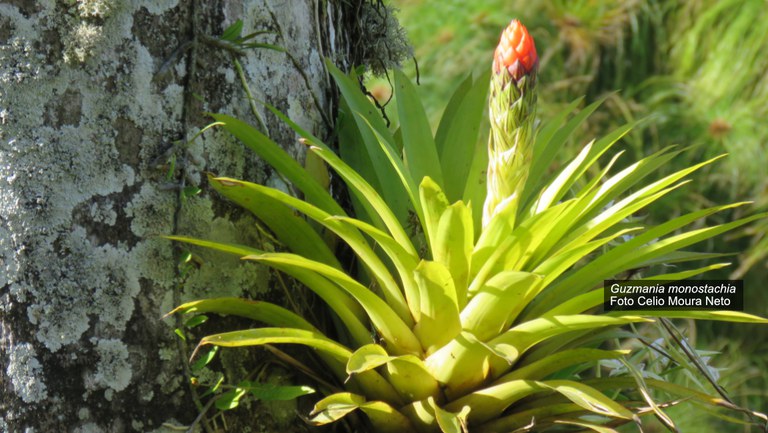
'Guzmania monostachia' (L.) Rusby ex Mez (Bromeliaceae) - Vulnerable (VU), PAN target species | Photo: Celio Moura Neto
The Rio de Janeiro Botanical Garden Research Institute (JBRJ), through the Coordination of Strategic Projects for the Conservation of Endangered Species of the National Center for Flora Conservation (COESC/CNCFlora), has begun drafting the National Action Plan for the Conservation of the Endangered Flora of the Ceará-Piauí Caatinga (PAN Flora da Caatinga). This is the first PAN dedicated exclusively to flora in the Caatinga domain.
The initiative is part of the scope of the Conservation, Restoration and Management Strategies for the Biodiversity of the Caatinga, Pampa and Pantanal Project, financed by the Global Environment Facility (GEF Terrestrial). The area covered by the plan, which exceeds 40,000 km², includes parts of the states of Ceará and Piauí, stretching from the southern portion of the Ibiapaba to the coast, bounded by the Acaraú River to the east and the Parnaíba River to the west. Browse the territory on the map.
The PAN Flora da Caatinga seeks to conserve 20 species of flora threatened with extinction. Among them, two (02) are categorized as “Critically Endangered (CR)”, eight (08) as “Endangered (EN)” and 10 as “Vulnerable (VU)”. Species such as Senegalia cearenses Terra & Garcia (VU), endemic to the state of Ceará, and Erythroxylum bezerrae Plowman (EN), endemic to both states, are among the highlights. In addition, seven (07) species classified as “Near Threatened (NT)” and three (03) with “Insufficient Data (DD)” will benefit.
On January 14, 16 and 21, the Preparatory Meeting was held in a virtual environment. The meeting brought together more than 30 representatives from universities, government bodies, NGOs and companies, including the Vale do Acaraú State University (UVA), the Federal Universities of Cariri (UFCA), Ceará (UFC), Delta do Parnaíba (UFDPAR) and Piauí (UFPI), the Ministry of the Environment and Climate Change (MMA), the Chico Mendes Institute for Biodiversity Conservation (ICMBio - PARNA de Ubajara, PARNA Sete Cidades and APA de Ibiapaba), the Secretariat for the Environment and Climate Change (SEMA-CE), the Caatinga Association and Transecto Soluções Ambientais, as well as CNCFlora Director Gustavo Martinelli and COESC/CNCFlora Project Coordinator Marcio Verdi and his team. During the meeting, the name of the plan, the geographical limits of its action and the main vectors of pressure threatening the target species were defined.

- Preparatory Meeting for the PAN Flora of the Caatinga

The next stage will be the Planning Workshop, scheduled for May 2025 in Fortaleza (CE). The event will bring together participants to agree on the objectives, actions, people responsible and products that will make up the PAN's Planning Matrix, a document that will guide its implementation over the next five years. The Technical Advisory Group (GAT), responsible for following up and monitoring the implementation of the plan, will also be defined.
The initiative reinforces the JBRJ's commitment to biodiversity conservation, expanding efforts to protect the flora of the Caatinga and mitigate the risks of extinction of endangered species.
National Action Plans
The National Action Plan for the Conservation of Endangered Species (PAN) is a public policy instrument that meets national and international goals, plans and strategies for biodiversity conservation, such as the Convention on Biological Diversity (CBD) and the Global Strategy for Plant Conservation (GSPC). These plans are drawn up and implemented in conjunction with society's stakeholders and aim to define and direct priority actions to reduce, suppress or mitigate the vectors of pressure that put species and their natural environments at risk, through public policies, environmental education, the creation of Conservation Units, monitoring and the recovery of ecosystems.
The GEF Terrestrial Project is coordinated by the Ministry of the Environment and Climate Change (MMA), financed by the Global Environment Facility Trust Fund (GEF), implemented by the Inter-American Development Bank (IDB) and has the Brazilian Biodiversity Fund (Funbio) as the executing agency.